
Words. We use them all the time. We use words orally when speaking, and we understand words when listening to others speak. But if we are able to communicate so well, then why do we sometimes need an illustration to further express what we mean? There is evidence suggesting that the addition of illustrations can facilitate in helping the writer better detail what they imagine in their brain more effectively.
An example of when illustrations convey more effectively than words is in a letter written by Rockwell Kent to his wife, Frances. The front of the letter is decorated with twelve sporadically placed writings. Some with singular words, others with a single sentence. At the top of the letter there is a drawing of his house, with lines of rain dragging across it. Above it is “Weather?” with an arrow linking it to the house. In the letter he states, “even the friendliness of this little house becomes a thing that hurts with you away” (More than Words) to accompany the doodle–commenting how Frances being away makes both himself and the house in pain from her absence. Below the rainy house, there is a drawing of a wilted flower with the word “Mood?” above it. This is Kent’s way of telling his wife how he has been feeling recently because the rain has been preventing him from painting outside.
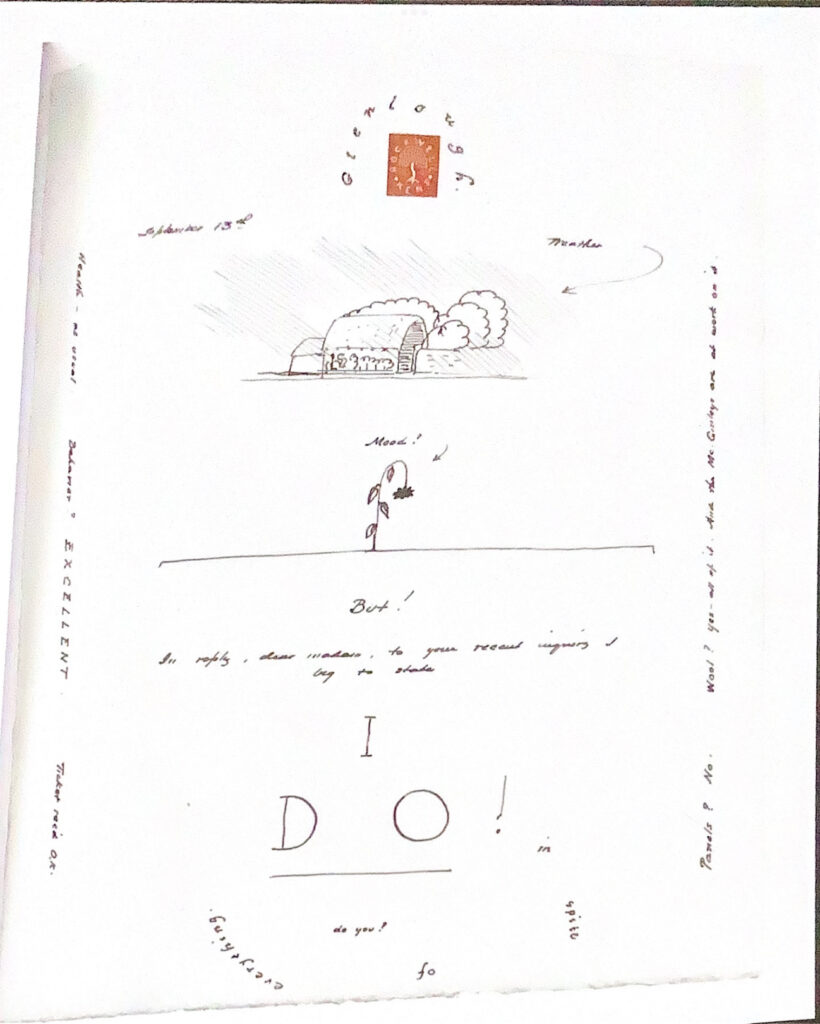
Rockwell Kent to Frances Kent
13 Sept. [1926]
A drawing can simply provide a visual, and not just be a way of expressing how someone feels. Tetsuzo (Ted) Hirasaki was a child who was living in a Japanese Internment Camp. He, as well as thousands of Japanese children and their families were forcibly removed from their homes and transported to live in Internment Camps. There was a librarian named Clara Breed who would send handwritten letters to the kids to keep their spirits high with her letters. Ted was one of those children. In the letter dating August 27, 1943, Ted writes about how a storm ripped the roofs completely off of the uncompleted school buildings. He says, “You see, the whole north side of the school building is made up of windows from the roof to average window sill height. [illustration of school building] That’s about how they look” (Tetsuzo (Ted) Hirasaki). As a child, Ted has a much more limited vocabulary, meaning that he can more effectively get his idea across by illustrating, with a loose estimate of the building’s measurements.
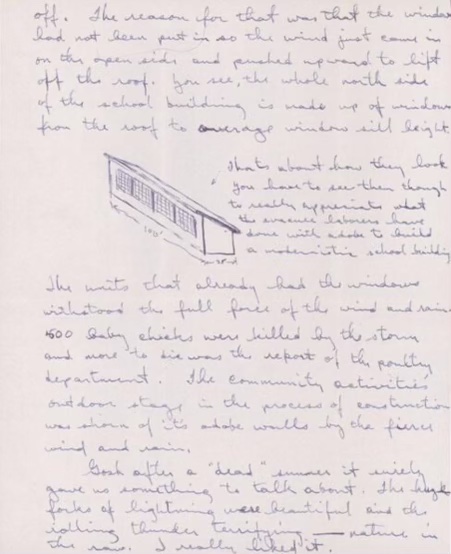
Tetsuzo Hirasaki to Clara Breed
August 27, 1943
However, an example of when an illustration adds more creativity, rather than clarification, is in a letter written by bronze sculptor Paul Suttman. He writes to his friends, Mimi Gross and Red Grooms saying, “We are all still here in Tavarnuzze, KK (Katharine Kean) fell off the [sketch of scooter] & broke her collarbone!!” from the bottom of a wine class (More than Words). This does not necessarily help the reader to visualize. Although there is a doodle of KK falling off her scooter in the letter, it serves as being both artsy and interesting, rather than “communicating.” Instead, the art is used to convey emotions. The thought of Paul Suttman writing the letter at the bottom of the wine glass, “drunk on the pleasures of Italy” (More than Words), is more of a way to be comical, rather than strengthening an explanation of something.
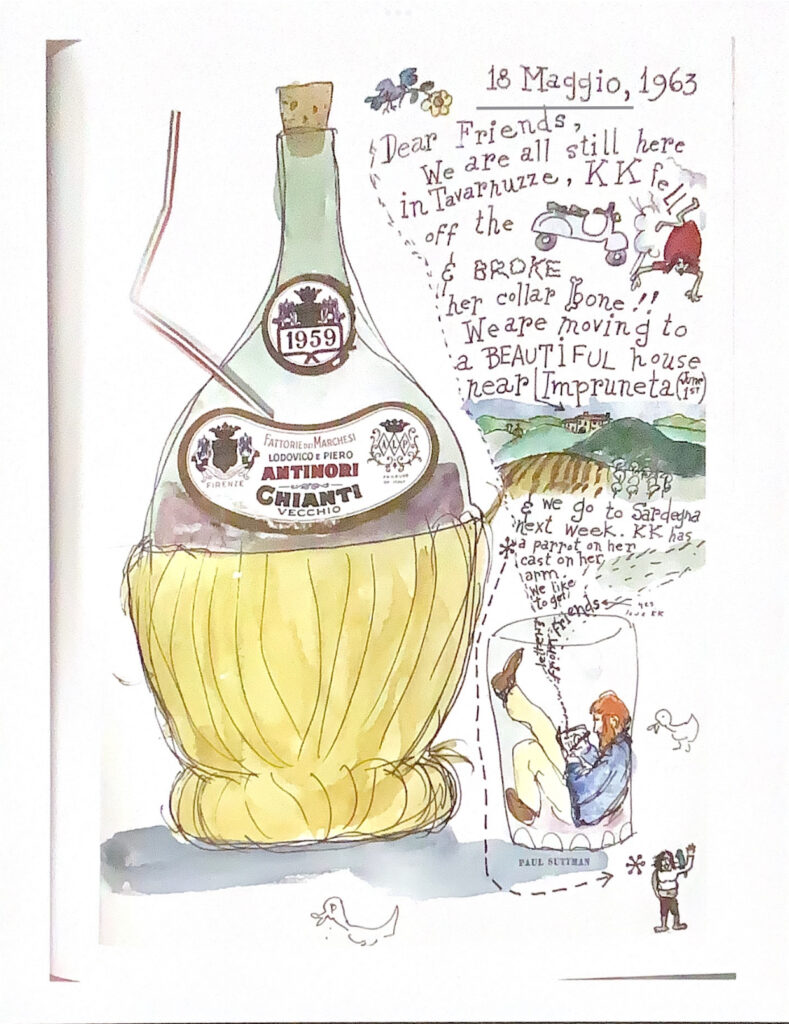
Paul Suttman to Red Grooms
18 May [1961]
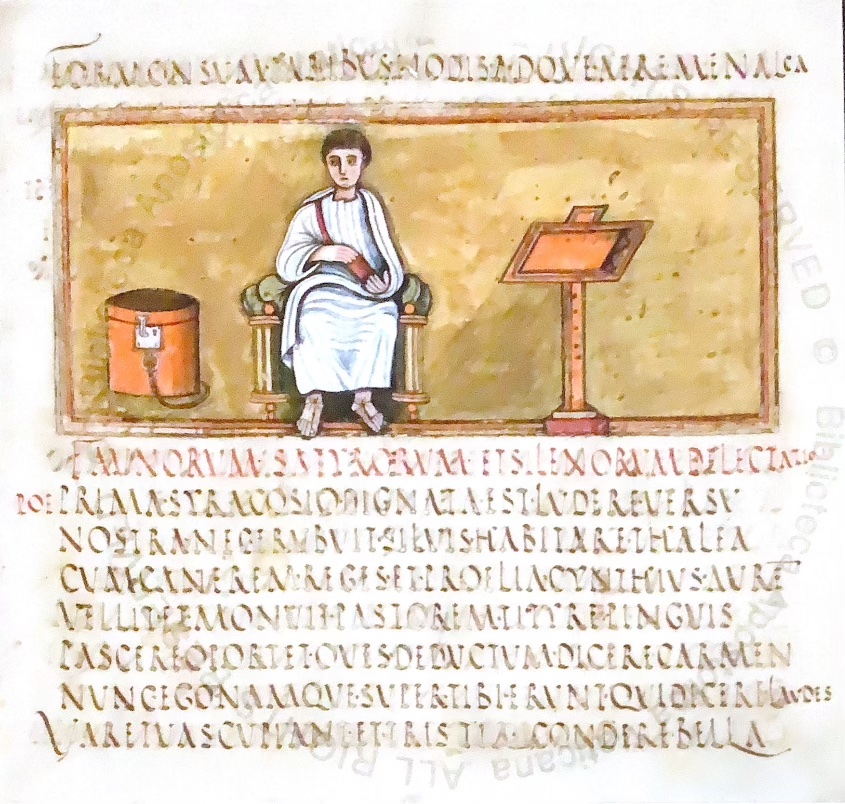
But what about the oldest form of combining words with a representation of them? This is where the Vergilius Romanus, the oldest surviving manuscript, becomes important. Of the estimated 410 folios, or pages, only 309 remain. Additionally, only 19 illustrations have survived of the original total of 42. Even more surprising is that this manuscript is from the 5th-century. This is identical to what we do now with social media: posting an image with a caption to go along with it.
With writing, there are considerable benefits to letter writing including the enhancement of students’ spatial skills, strengthening of their cognitive skills, improvement of both their overall well being and physical health, as well as helping you think (NIH). If the literary aid of including illustrations with your letters was not enough evidence, then what about the scientific benefits of writing letters?
Recently, there has been a focus on the importances of both Explanational Learning and Visual Learning. While utilizing Explanational Learning does leave room for spatial inferences and is only truly effective if you are able to communicate well, it does allow for more artistic means of communication. In contrast, according to the National Center for Biotechnology Information, “Creating visual explanations is likely to enhance students’ spatial thinking skills, skills that are increasingly needed in the contemporary and future world” (NIH). Visual Learning has been found to add more clarification to Explanational Learning along with being able to directly communicate more effectively.
Why has there been a gradual disappearance of illustrations in writings, despite having so much information supporting its inclusion? There are a bunch of possible reasons, with some overlap. For one, the recent rise in digital use has lessened the need for illustrations; there is a greater focus on writing via emails and text messages, rather than letters. The shift towards technology has resulted in a decreased interest in letter writing, and as a result, has become a less popular market. With the introduction of the printer, the change to utilizing technology more was foreseeable.
But has illustrated work actually, and truly disappeared, despite there being a declining market? The short answer is no. The long answer, however, requires an overview of comic books. At the beginning of the 20th century, children’s books and comic books were the only examples of written work to include illustrations. The inclusion of illustrations in comic books makes sense because it serves as a visual rendition of the words on the page for the younger readers. However, the majority of the audience for comic books is around 35 years old (Gitnux). The purpose of illustrations transforms from comprehension to adding more to the experience of reading.
Even though it may seem like the idea of letter writing is dated and is fading out, it is not. Instead, it has evolved into new, various forms of writing–with these primarily being comics. Just because something has drastically changed, does not automatically mean that it is bad or negative. It’s just different.
